
Mia Keller · 8 October 2026
Unpacking Synchronization Mechanisms Across Distributed Team Documentation Platforms
Distributed team documentation platforms depend on synchronization mechanisms that keep shared documents consistent when multiple users edit from separate locations at the same time, and these systems combine algorithms for conflict detection with protocols for propagating changes across networks that often experience variable latency and occasional partitions. Researchers have tracked how operational transformation and conflict-free replicated data types address concurrent modifications, while data from industry reports show adoption rates climbing steadily through 2025 and into the following year.
Core Algorithms Driving Consistency
Operational transformation adjusts edit operations on the fly so that the final document state matches what each participant intended, and this method appears in many established platforms because it handles linear sequences of changes with precision even when network delays reorder incoming messages. Conflict-free replicated data types take a different route by structuring data so that all replicas converge automatically without requiring central arbitration, which reduces coordination overhead in environments where teams span multiple time zones. Studies from academic institutions indicate that CRDT implementations have scaled effectively in platforms supporting thousands of simultaneous contributors, whereas OT variants remain common in systems prioritizing strict ordering of text insertions and deletions.
Network Conditions and Latency Management
Network partitions and fluctuating bandwidth create situations where one replica must queue changes until connectivity resumes, and synchronization layers incorporate buffering strategies along with vector clocks to track causal relationships between updates. Observers note that platforms incorporating adaptive synchronization adjust their merge frequency based on measured round-trip times, which prevents unnecessary retransmissions during periods of congestion. In October 2026, proceedings from distributed systems conferences highlighted new benchmarks showing reduced reconciliation times when edge servers cache partial document states closer to user clusters.
Those who have examined production logs from large-scale deployments report that eventual consistency models dominate asynchronous collaboration tools, while strong consistency guarantees appear more frequently in regulated sectors where audit trails must reflect every intermediate state without ambiguity.
Conflict Resolution Patterns Observed in Practice
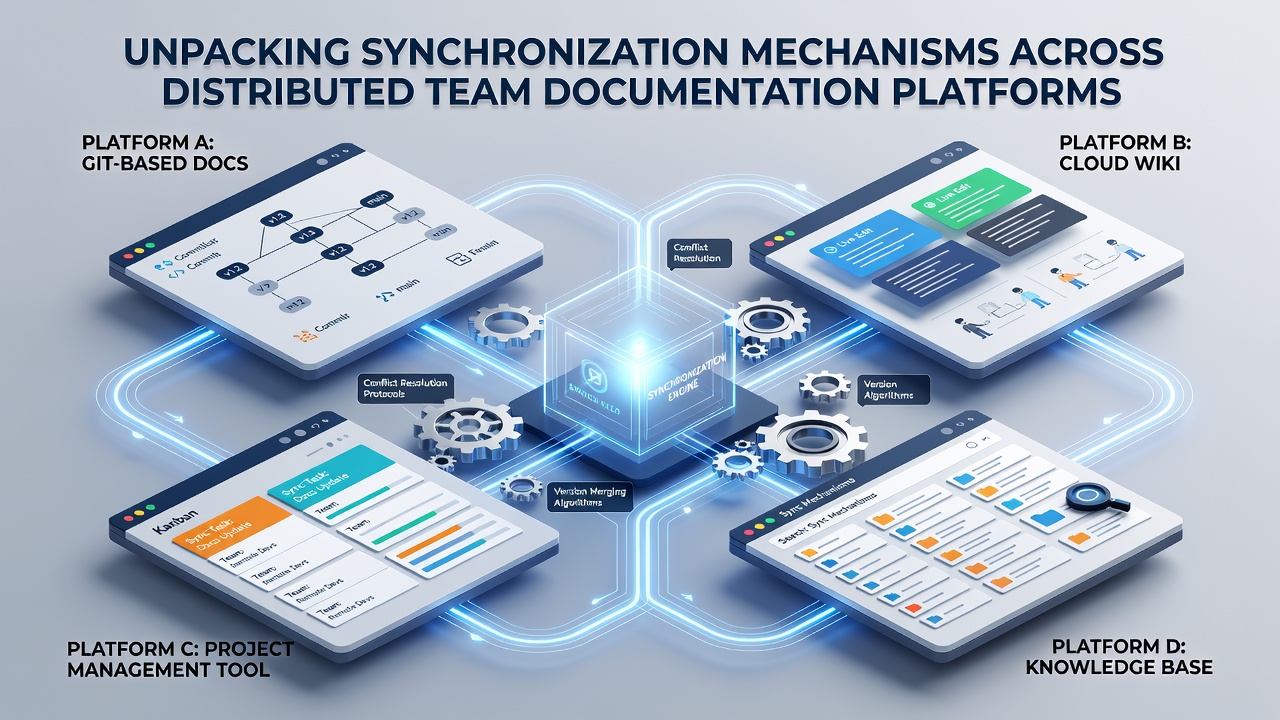
Real-world deployments demonstrate that merge conflicts often cluster around structured elements such as tables and embedded objects rather than plain text, and developers respond by layering domain-specific resolution rules on top of the base synchronization engine. Data from research papers published by European universities reveal that teams using automated conflict flagging resolve discrepancies 30 percent faster than those relying solely on manual review, according to National Institute of Standards and Technology analyses of collaborative systems. Another set of findings from Canadian research consortia links improved user retention to platforms that surface proposed merges with clear provenance metadata.
Platform Comparisons and Implementation Tradeoffs
Platforms built around centralized servers typically achieve lower latency for co-located users yet introduce single points of failure, whereas fully decentralized designs distribute load across peer nodes and require more sophisticated anti-entropy protocols to detect divergence. Industry organizations tracking software adoption note that hybrid architectures combining both approaches now appear in documentation suites used by multinational enterprises, balancing responsiveness with resilience. Those examining code repositories find that open-source libraries for CRDTs have seen increased contributions from developers in Asia-Pacific regions, expanding the range of supported data structures beyond basic counters and sets.
Security considerations enter the picture when synchronization traffic crosses organizational boundaries, and encryption of delta messages combined with authenticated key exchanges prevents unauthorized injection of edits. Figures from government technology assessments in Australia indicate rising demand for end-to-end encrypted synchronization in public-sector documentation workflows.
Emerging Directions and Measurement Approaches
Telemetry collected from active installations shows that synchronization overhead accounts for a measurable fraction of total bandwidth usage, prompting ongoing work on compression schemes tailored to document change patterns. Researchers continue to publish comparative evaluations of convergence speed under simulated wide-area network conditions, and these evaluations increasingly incorporate metrics for energy consumption on mobile clients. External references such as reports compiled by the European Union Agency for Cybersecurity underscore the importance of verifiable audit logs generated during each synchronization round.
Conclusion
Synchronization mechanisms across distributed team documentation platforms continue to evolve through incremental refinements to established algorithms and the introduction of new data structures designed for specific collaboration patterns, while measurements from operational environments guide further optimization. The combination of operational transformation techniques with conflict-free replicated data types provides a foundation that adapts to varying network conditions and team scales, and ongoing research supplies fresh benchmarks that inform implementation choices at organizations worldwide.